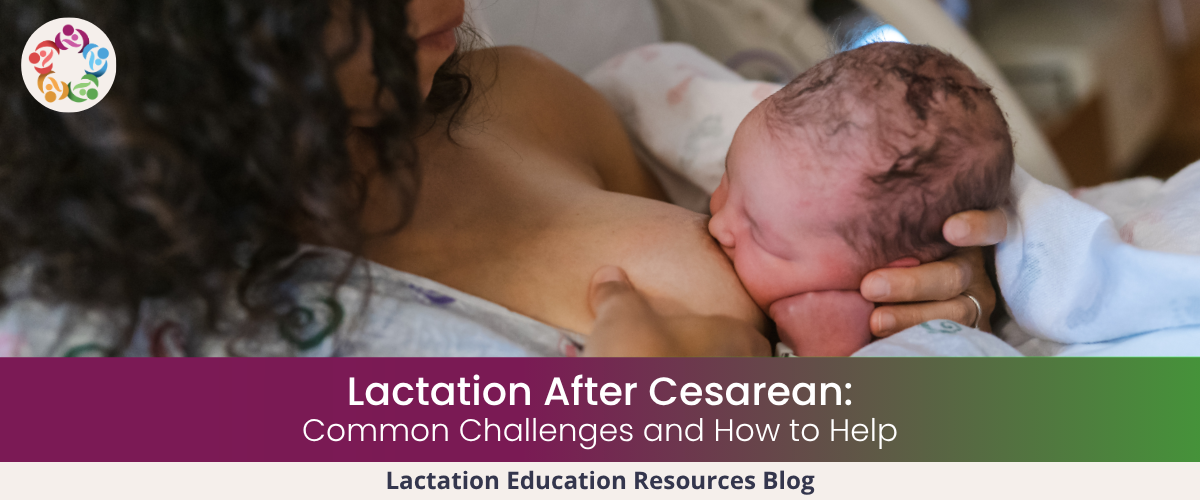
If you work with birthing families, you will encounter cesarean birth, and the lactation challenges that can follow. Whether a cesarean was planned or unexpected, the experience introduces a unique set of hurdles for the breastfeeding dyad.
The good news: With the right knowledge and support, most of these challenges can be overcome. Here's a practical rundown of the most common lactation issues after cesarean birth, and the best guidance the research has to offer.
If You Know a Cesarean Is Coming: The Prenatal Opportunity
When a cesarean is planned, there's a valuable window that doesn't exist for unplanned cesarean births: time to prepare. A prenatal lactation consultation can meaningfully change how a family experiences those first days.
Sarah Stilling, PNP, emphasizes in her LER course Facilitators and Barriers to Initiation of Lactation that prenatal combined with postnatal interventions are more effective than usual care in prolonging breastfeeding duration.
Use the time before birth to:
- Set realistic expectations. Walk families through the challenges below (delayed milk onset, a potentially sleepy baby, positioning limitations) so they aren't blindsided when they occur. Families who know what's coming are far better equipped to stay the course.
- Practice hand expression. Dr. Allison Ward Moore, OB-GYN and IBCLC, recommends in her LER course Postpartum Recovery and Its Effects on Lactation encouraging families to practice in the final weeks of pregnancy so the skill is ready when they need it most.
- Discuss skin-to-skin in the OR. Where it is supported, intraoperative skin-to-skin significantly improves exclusive breastfeeding rates after cesarean birth. Families should know it's possible, and know to ask for it.
And When the Cesarean Wasn't Planned...
The following challenges apply to any cesarean birth, planned or not. But parents who didn't expect to deliver surgically may be navigating all of this while also processing a birth experience that didn't go as hoped. Your skilled support can make all the difference.
Delayed Milk Onset
The Challenge: It's one of the most common and discouraging experiences after cesarean birth: milk that takes longer to arrive. Research has consistently found that cesarean birth is associated with delayed Lactogenesis 2, the onset of copious milk production.
Dr. Ward Moore explains in Postpartum Recovery and Its Effects on Lactation that there are likely many factors involved: pain, limited mobility, fewer early feedings, physical separation after surgery, and the surgery itself potentially impacting prolactin levels. For a parent who is already exhausted and recovering, a slow milk onset can feel like one more thing going wrong.
Your Best Advice: Reassure first, then act. Early and frequent milk removal is essential, and if the baby isn't latching well in the first hours, hand expression is a powerful tool. Dr. Ward Moore notes that greater than five hand expressions per day in the first three days improves daily volumes at eight weeks. Help families hold onto hope: a slow start is not a sign that milk won't come. It very likely will, with support.
Perceived Excessive Weight Loss Due to IV Fluids
The Challenge: Cesarean births typically involve significant IV fluid administration, and this can set up a scenario that worries everyone: a baby who appears to be losing too much weight.
Courtney Polk, RN, IBCLC, explains in her LER course From Birth to Breast: The Effects of Labor Medications on Lactation that IV fluids administered to the mother during labor and birth can artificially inflate a baby's birth weight. When the baby sheds that excess fluid in the days after birth, it can look like alarming weight loss, sometimes triggering unnecessary supplementation. For a parent already anxious about feeding, this can feel like confirmation that something is wrong.
Your Best Advice: Help families understand what's actually happening. The weight loss is largely physiological fluid loss, not a sign that the baby isn't getting enough. Monitoring wet diapers and feeding cues alongside weight often gives a much more complete and reassuring picture.
Positioning, Lifting, and Holding Baby
The Challenge: A cesarean is major abdominal surgery, and the incision site creates real physical limitations, especially in those first days. Lifting restrictions (typically nothing over ten pounds) apply, and parents sometimes need a gentle reminder that they just had significant surgery, even when they're beginning to feel better and their instincts are telling them to do everything for their baby.
Your Best Advice: Dalaney Young, IBCLC, points out in her LER course Essentials of Latch and Positioning that football hold is especially helpful after cesarean birth because it removes pressure from the incision site entirely. Dr. Ward Moore adds that side-lying is another comfortable option. A few simple tools (rolled receiving blankets, extra pillows for back support) can make a meaningful difference in those early days and help a parent feel capable rather than limited.
Sleepy Baby
The Challenge: After a cesarean, baby may be hard to rouse and slow to show feeding cues. Polk notes in From Birth to Breast that anesthesia medications cross the placenta and can result in temporary drowsiness and a dulled suckling reflex. Disorganized suck rhythm is also common. This can be confusing and discouraging for parents who are working hard and still struggling to get a good feed.
Your Best Advice: Skin-to-skin contact is your best tool here. It naturally stimulates feeding behaviors even in a sleepy baby, and it's something parents can do right now to feel connected and helpful. Help families recognize early feeding cues, before the baby reaches the crying stage, so that feeding attempts happen while the baby is in a more receptive, quiet-alert state. And remind them: This phase is temporary. Feeding behavior typically improves within days.
Pain Medications and Breastfeeding Safety Concerns
The Challenge: Many parents worry that the pain medications they need after a cesarean will harm their baby through breast milk. It's an understandable concern, and one worth taking seriously. But that worry can itself become a barrier, leading parents to under-treat their pain and then struggle to relax and feed effectively.
Your Best Advice: Dr. Ward Moore emphasizes in Postpartum Recovery and Its Effects on Lactation that maximizing non-narcotic pain relief, scheduled ibuprofen and acetaminophen at full doses, reduces the need for opioids. When opioids are necessary, she notes that common postpartum options are considered safe while breastfeeding at typical doses, though families should watch for unusual drowsiness in the baby.
The message worth repeating: Untreated pain is itself a barrier to breastfeeding. Adequate pain control is lactation support. Reliable resources like LactMed and Hale's Medications and Mothers' Milk can help when questions arise about specific medications.
When Birth Didn't Go as Planned
The Challenge: For many families, cesarean birth, especially an unplanned one, carries emotional weight that goes well beyond the physical recovery. Sarah Stilling, PNP, notes in Facilitators and Barriers to Initiation of Lactation that stressful birth experiences are associated with delayed Lactogenesis 2 and can significantly impact breastfeeding initiation. A parent who is grieving a birth experience they didn't have needs support to process that grief.
Your Best Advice: Ask open-ended questions. Listen first. Honor their experience before moving to the clinical work. Breastfeeding and skin-to-skin contact may be the one thing that helps normalize a difficult birth experience, and the oxytocin released can actively support mood and reduce stress. Dr. Ward Moore reminds us that a parent who feels seen and supported is far more likely to stay engaged with the feeding relationship. That starts with you.
Ready to Learn More?
- Postpartum Recovery and Its Effects on Lactation
- From Birth to Breast: The Effects of Labor Medications on Lactation
- Facilitators and Barriers to Initiation of Lactation
- Essentials of Latch and Positioning
Each course offers in-depth, evidence-based education to help you better support every family you serve, including those navigating the unique challenges of cesarean birth.
Browse All LER Courses